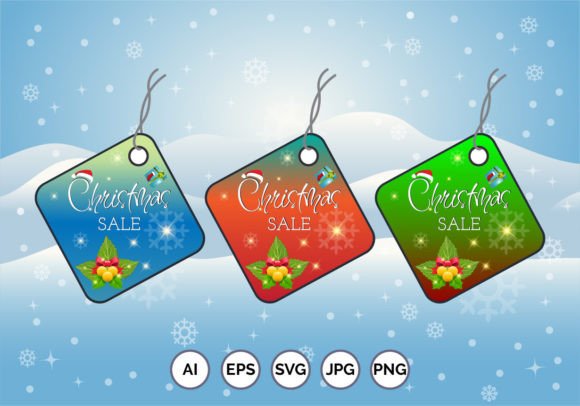
Review: Christmas Sale Badge and Tag Vector for Holiday Embroidery
As a designer who spends more time staring at stitch simulations than actual holiday decorations, I approach every new machine embroidery design with a mix of excitement and skepticism. When I first pulled up the Christmas Sale Badge and Tag Vector on my screen, my immediate reaction was one of practical appreciation. In the world of Illustrations, there is often a disconnect between what looks good on a flat monitor and what survives the tension of a hoop. This asset, however, feels purpose-built for the tangible reality of a craft business during the busiest season of the year.
First Impressions: A Balance of Festive and Functional
The visual personality of this design strikes a careful balance. It avoids the overly cloying cuteness that can sometimes cheapen a handmade product, opting instead for a clean, badge-like aesthetic that suggests professionalism. The layout is compact, which is crucial for modern apparel where oversized graphics are falling out of favor in lieu of subtle, high-quality branding. The theme is unmistakably holiday, yet the "Sale" and "Tag" elements give it a commercial utility that extends beyond simple decoration. It feels like something you would find on a boutique garment rather than a mass-produced big-box store item.
For an Etsy seller or small shop owner, the mood this design creates is one of curated exclusivity. It signals to the customer that attention has been paid to detail. Whether rendered in traditional reds and greens or a more sophisticated monochrome palette, the shape and flow suggest a design that will hold its integrity under the needle. It is not just a picture; it is a functional graphic element ready to become a finished product.
Real-World Application: The Boutique Sweatshirt Scenario
To truly evaluate the Christmas Sale Badge and Tag Vector, I imagined a specific real-life scenario: preparing a limited run of custom sweatshirts for a local holiday market. The goal was to create a personalized gift option that customers could buy off the rack while also offering quick customization. This design fits perfectly on the left chest of a heavy cotton blend sweatshirt. Unlike complex scenic applique design files that require multiple fabric changes and extensive trimming, this vector-based approach translates well into dense fill stitch work or crisp satin stitch borders.
In this context, the design acts as a brand stamp. If I were stitching this onto a tote bag design for a holiday shopper, the clarity of the lines would ensure readability from a distance. For baby embroidery projects, such as a festive onesie or a nursery pillow cover, the scale can be reduced without losing the essential character of the badge, provided the stitch density is adjusted for softer fabrics. The versatility allows it to transition seamlessly from a holiday embroidery accent on a kitchen towel to a primary logo on a custom apparel line.
Navigating Fabric Challenges and Stitch Clarity
However, no design is without its constraints, and a responsible review must address where caution is needed. The intricate nature of a "tag" concept often involves simulated text or fine linear details. When working with textured fabrics like waffle knits or looped towels, these finer elements of the Christmas Sale Badge and Tag Vector might get lost. In such cases, I would recommend increasing the size slightly or simplifying the internal details to prevent the running stitch elements from sinking into the pile.
Stretchy fabrics present another consideration. If you are applying this to a fitted cap or a thin rayon shirt, the stability of the design becomes paramount. A badge shape with solid fill areas can become stiff if the stitch density is too high. For curved surfaces like caps, ensuring the underlay is sufficient to prevent puckering is critical. Furthermore, on dark fabrics, the contrast of the thread colors must be meticulously chosen. A design that relies on subtle shading in a printable mockup might look muddy in thread if the color transitions aren't distinct enough. Always test your embroidery file on a scrap piece of the actual fabric you intend to use.
Enhancing Brand Value and Customer Trust
Beyond the technical execution, the choice of design assets directly influences perceived value. Using a cohesive, well-structured graphic like this badge elevates the presentation of any small shop product. It conveys a sense of permanence and quality that hand-lettering or haphazard layouts often lack. For commercial embroidery projects, consistency is key to building brand recognition. This vector provides a reliable anchor for holiday collections, ensuring that whether a customer buys a hat, an apron, or a patch, the branding remains uniform.
From a buyer's perspective, seeing a clean, professional badge stitched onto a garment increases trust. It suggests that the maker cares about the longevity and appearance of the item. This is particularly important for items intended as gifts, where the presentation is half the experience. A sloppy or poorly scaled design can undermine the sentiment of a personalized gift, whereas a sharp, clear badge reinforces the thoughtfulness of the purchase.
Practical Notes for the Working Designer
Before committing to a full production run with the Christmas Sale Badge and Tag Vector, there are several steps I strongly advise. First, always stitch out a test sample on scrap fabric identical to your final material. Pay close attention to the corners of the badge shape; sharp angles can sometimes pull or bunch if the digitizing isn't optimized for your specific machine tension. Check the hoop size requirements carefully to ensure the design fits your available workspace without needing re-hooping, which can lead to alignment issues.
It is also wise to view the design in black and white. This strips away the distraction of color and reveals whether the contrast and form are strong enough to stand on their own. If the design relies entirely on color shifts to define its shape, it may fail on single-color garments or when viewed from a distance. Additionally, verify the licensing terms associated with the digital embroidery file. While many assets are suitable for personal use, selling finished items or using them as part of a larger design assets package for clients may require a specific commercial license. Never assume; always confirm.
Finally, consider the care instructions for the end user. Dense badge designs can affect the drape and breathability of lightweight fabrics. If this is going onto a baby embroidery project or a summer tee that happens to be holiday-themed, ensure the back of the stitching is covered or trimmed neatly to prevent skin irritation. With proper preparation and a keen eye for detail, this vector serves as a robust foundation for a successful holiday season, bridging the gap between digital creativity and physical craftsmanship.